montessori syllabus pdf

Montessori Syllabus: A Comprehensive Overview (2026)
Today, April 21st, 2026, accessing a Montessori syllabus PDF offers detailed guidance for educators and parents, blending computer architecture insights with pedagogical approaches.
What is a Montessori Syllabus?
A Montessori syllabus, often available as a PDF document, isn’t a rigid, prescriptive curriculum like those found in traditional educational settings. Instead, it functions as a comprehensive guide outlining the philosophical underpinnings, learning objectives, and developmental milestones within the Montessori approach. These PDF syllabi detail a carefully prepared learning environment designed to foster independence, self-directed learning, and a love for exploration.
The core of a Montessori syllabus PDF lies in its emphasis on observing the child’s individual needs and tailoring the learning experience accordingly. It maps out sequential activities across various areas – practical life, sensorial, language, mathematics, and culture – but allows for flexibility based on the child’s pace and interests. A well-structured PDF syllabus will also include information on materials, presentation techniques, and assessment strategies, offering a holistic view of the Montessori method.

Furthermore, these PDF resources often reflect specific Montessori certifications (AMI or AMS), influencing the curriculum’s nuances and implementation guidelines.
The Core Principles of Montessori Education
Montessori education, detailed within a comprehensive syllabus PDF, centers around several core principles. Firstly, it champions the “absorbent mind,” recognizing children’s innate capacity to learn effortlessly during sensitive periods. A syllabus PDF illustrates how environments are structured to capitalize on these periods. Secondly, independence is paramount; the PDF outlines activities promoting self-sufficiency and problem-solving.
Thirdly, freedom within limits is crucial, allowing children to choose activities within a structured framework, as detailed in the PDF’s lesson plans. Fourthly, the prepared environment – a key element explained in syllabus PDFs – is designed to support exploration and discovery.
Finally, observation is central to the Montessori approach; teachers, guided by the syllabus PDF, carefully observe each child to understand their individual needs and tailor learning accordingly. These principles, thoroughly documented in a Montessori syllabus PDF, form the foundation of this unique educational philosophy.
Historical Context of the Montessori Method
The Montessori method, meticulously outlined in modern syllabus PDFs, originated with Dr. Maria Montessori’s pioneering work in the early 20th century. Initially focused on children with intellectual disabilities, her approach demonstrated remarkable success, prompting her to apply it to mainstream education. Early syllabus materials, precursors to today’s PDF formats, detailed her observations and techniques.
Montessori’s Casa dei Bambini (“Children’s House”) in Rome served as a laboratory for her ideas, documented in evolving curriculum guides – the ancestors of current syllabus PDFs. These early documents emphasized child-led learning and a prepared environment.
The method gained international recognition, spreading globally despite facing periods of resistance. Contemporary syllabus PDFs reflect this rich history, incorporating both Montessori’s original principles and modern educational research. Accessing a syllabus PDF provides insight into this enduring legacy and its continued relevance today.

Montessori Syllabus by Age Group
PDF syllabi categorize learning by developmental stages—infant/toddler, preschool, and elementary—providing age-appropriate activities and materials for optimal growth and exploration.

Infant/Toddler (0-3 Years) — Key Areas
Montessori PDF syllabi for this age group emphasize sensorial exploration and practical life skills. Detailed lesson plans within these documents outline activities designed to refine the child’s senses – visual, auditory, tactile, olfactory, and gustatory – through carefully curated materials. These materials aren’t simply toys; they’re tools for developing discrimination and concentration.
Practical life exercises, also thoroughly detailed in the PDF, focus on fostering independence and coordination. Activities like pouring, spooning, dressing frames, and simple cleaning tasks allow infants and toddlers to master self-care and contribute to their environment. The syllabus highlights the importance of a prepared environment, mirroring the adult world on a child’s scale, and the teacher’s role as a careful observer and guide, documented within the PDF’s assessment guidelines.
Sensorial Development in Early Childhood
Montessori PDF syllabi dedicate significant attention to sensorial development, outlining a progressive sequence of materials designed to isolate specific qualities like color, shape, size, texture, and weight. These aren’t abstract concepts presented through rote learning; instead, children manipulate concrete objects, building a foundation for future academic learning. The PDF details how Pink Tower, Brown Stair, and Color Tablets refine visual discrimination.
Further, the syllabus emphasizes the importance of tactile exploration through fabric boxes and pairing cards. These activities, meticulously described within the PDF, aren’t merely about identifying sensations; they’re about developing the child’s ability to categorize, compare, and contrast. Observation checklists within the PDF guide teachers in documenting each child’s progress, ensuring individualized learning paths are followed, fostering a love for learning.
Practical Life Skills for Infants & Toddlers
A comprehensive Montessori PDF syllabus highlights Practical Life as foundational for infants and toddlers, extending beyond academics to encompass self-sufficiency and coordination. These activities, detailed within the PDF, aren’t simply “busy work”; they’re carefully designed to mimic real-world tasks, fostering independence. Expect sections on pouring, spooning, transferring, and buttoning frames, all presented with clear material lists and step-by-step instructions.
The PDF emphasizes the importance of a prepared environment, showcasing how child-sized furniture and accessible materials encourage exploration. Observation guides within the PDF assist teachers in identifying a child’s readiness for each skill. Furthermore, the syllabus details how these activities contribute to concentration, order, and a sense of accomplishment, building confidence and preparing them for more complex tasks later on.
Preschool (3-6 Years) — The Foundation Years
A Montessori PDF syllabus for the 3-6 age group meticulously outlines a period of immense growth, focusing on sensorial exploration and early academic concepts. These PDF resources detail how the preschool years build upon Practical Life skills, introducing children to language, mathematics, and cultural studies through hands-on materials. Expect comprehensive lesson plans covering phonics, number recognition, and basic geography.

The PDF emphasizes the interconnectedness of subjects, demonstrating how activities seamlessly integrate different areas of learning. Observation checklists within the PDF help teachers track individual progress and tailor lessons accordingly. Furthermore, the syllabus highlights the importance of fostering independence, concentration, and a love of learning, preparing children for the transition to elementary education.
Language Development in the Montessori Preschool
Montessori PDF syllabi for preschool language arts detail a phonetic approach, beginning with sound recognition and progressing to letter formation and writing. These PDF resources showcase materials like sandpaper letters, movable alphabets, and picture cards, fostering a multi-sensory learning experience. Expect detailed lesson plans for vocabulary enrichment, grammar introduction, and early reading skills.
The PDF syllabus emphasizes a child-led pace, allowing children to progress at their own speed. It outlines activities to encourage oral language development, storytelling, and creative expression. Assessment guidelines within the PDF focus on observing a child’s ability to articulate thoughts and comprehend language, rather than standardized testing. The goal is to cultivate a lifelong love for language and communication.
A Montessori PDF syllabus for early mathematics introduces concepts concretely, using manipulatives like golden beads, number rods, and spindle boxes. These PDF resources detail a progression from understanding quantity to symbolic representation, avoiding rote memorization. Lesson plans within the PDF focus on developing number sense, sequencing, and basic arithmetic operations – addition, subtraction, multiplication, and division – through hands-on activities.
The PDF syllabus emphasizes a gradual introduction of abstract concepts, building upon a solid foundation of concrete experiences. It outlines activities to foster pattern recognition, problem-solving skills, and a positive attitude towards mathematics. Assessment within the PDF focuses on observing a child’s understanding of mathematical principles, not just correct answers.
Cultural Studies: Geography, History, Science (3-6)
Montessori PDF syllabi for cultural studies (ages 3-6) integrate geography, history, and science through sensorial experiences and hands-on exploration. These PDF resources often include continent puzzles, land and water form trays, and timelines to introduce children to the world and its history. Science concepts, detailed in the PDF, are presented through botany, zoology, and simple physics experiments.
The PDF syllabus emphasizes interconnectedness, showing how different cultures and environments relate to one another. Lesson plans within the PDF encourage children to develop a sense of wonder and respect for the natural world and human societies. Assessment, as outlined in the PDF, focuses on observation of engagement and understanding, rather than formal testing.
Elementary (6-12 Years) ― Expanding Horizons
A Montessori PDF syllabus for the elementary years (6-12) signifies a shift towards abstract thinking and independent research. These PDF documents detail a curriculum built around “Great Lessons”—narrative presentations introducing the origins of the universe, life, and humanity. The PDF outlines how children explore these concepts through follow-up work in various subject areas.
The PDF syllabus emphasizes an integrated curriculum, connecting subjects like history, science, geography, and language arts. It details projects requiring research, collaboration, and presentation skills. Assessment, as described in the PDF, moves beyond basic recall to evaluate critical thinking and problem-solving abilities. The PDF also guides teachers in fostering a love of learning and self-direction.
Integrated Curriculum Approach (Elementary)
The elementary Montessori PDF syllabus champions an integrated curriculum, moving away from isolated subject teaching. These PDF resources demonstrate how concepts interrelate, fostering a holistic understanding. For example, a history lesson might connect to geography, art, and writing assignments, all detailed within the PDF.
A typical PDF syllabus will showcase “Great Lessons” as foundational narratives, sparking inquiry across disciplines. The PDF outlines project-based learning, where students investigate topics in depth, applying knowledge from multiple areas. Assessment, as presented in the PDF, focuses on the connections students make and their ability to synthesize information. The PDF emphasizes real-world applications and encourages students to see learning as interconnected.
Advanced Mathematics Concepts (6-12)
Montessori PDF syllabi for the 6-12 age group introduce advanced mathematical concepts through concrete materials, building upon earlier foundations. These PDF resources detail the progression from basic operations to geometry, algebra, and even introductory calculus concepts. The PDF emphasizes understanding why mathematical principles work, not just how to apply them.
A well-structured PDF syllabus will showcase the use of materials like the binomial and trinomial cubes, golden beads, and specialized charts to visualize abstract ideas. The PDF outlines how students move from concrete manipulation to abstract representation, fostering a deep conceptual grasp. Assessment, detailed in the PDF, focuses on problem-solving and applying mathematical thinking to real-world scenarios, rather than rote memorization;
Research and Independent Learning (Elementary)
Montessori PDF syllabi for elementary students (6-12) heavily emphasize research and independent learning skills. These PDF documents outline how children are guided to formulate questions, gather information from diverse sources, and present their findings. The PDF details a shift from teacher-led instruction to student-directed exploration, fostering intrinsic motivation.
A comprehensive PDF syllabus will showcase projects involving in-depth study of chosen topics, utilizing library resources and, increasingly, curated online materials. The PDF stresses the importance of note-taking, outlining, and synthesizing information. Assessment, as described in the PDF, focuses on the research process itself – critical thinking, source evaluation, and clear communication – rather than simply recalling facts.

Key Components of a Montessori PDF Syllabus
Montessori PDF syllabi contain detailed lesson plans, material lists, observation guidelines, and strategies for effective parent communication, fostering a collaborative learning environment.
Detailed Lesson Plans & Materials Lists
Montessori syllabus PDFs excel in providing meticulously crafted lesson plans, often broken down by developmental area and age group. These plans aren’t merely outlines; they detail specific objectives, step-by-step procedures for presentation, and expected outcomes for the child. Crucially, they emphasize observation as the foundation for adapting lessons to individual needs.
Accompanying these plans are comprehensive materials lists. A quality syllabus won’t just name the materials, but will specify quantities, sources (where applicable), and even suggestions for creating homemade alternatives, promoting accessibility. The lists often categorize materials by subject – sensorial, practical life, language, math, and culture – streamlining preparation. Furthermore, PDFs frequently include images or diagrams of the materials, aiding in correct identification and usage. This level of detail ensures consistency and fidelity to the Montessori approach, whether used in a classroom or a home learning environment.
Observation & Assessment Guidelines
Montessori syllabus PDFs fundamentally shift the focus from traditional testing to continuous observation as the primary assessment tool. They detail how to observe – what specific behaviors to look for, recording methods (anecdotal notes, checklists), and the importance of unbiased observation. These guidelines emphasize observing the child’s engagement, concentration, independence, and problem-solving skills, rather than simply evaluating correct answers.

The PDFs articulate that assessment isn’t about grading, but about understanding each child’s developmental progress and tailoring the environment accordingly; They often include sample observation forms and guidance on interpreting observations to create individualized learning plans. Furthermore, they stress the importance of documenting progress over time, showcasing growth in various areas. This observational approach, detailed within the syllabus, fosters a deeper understanding of the child’s unique learning journey.
Parent Involvement & Communication Strategies
Montessori syllabus PDFs consistently highlight parent involvement as crucial for a child’s success. They outline strategies for fostering a strong home-school connection, emphasizing regular communication between teachers and parents. These PDFs often suggest parent-teacher conferences focused on observing the child’s work and discussing developmental progress, not just grades.
Detailed within these resources are ideas for workshops and presentations for parents, explaining the Montessori philosophy and how they can support learning at home. The syllabus PDFs advocate for creating a prepared environment at home, mirroring the classroom, and encouraging independent exploration. They also suggest ways parents can observe their child’s interests and provide related materials, strengthening the learning loop. Consistent, open communication, as detailed in the PDF, builds a collaborative partnership.

Finding & Utilizing Montessori Syllabus PDFs
Montessori syllabus PDFs are readily available online from accredited sources, offering structured learning plans and insights into the method’s core principles and practices.
Reputable Sources for Montessori Curriculum
Accessing reliable Montessori syllabus PDFs requires discerning credible sources. The Association Montessori Internationale (AMI) and the American Montessori Society (AMS) websites are excellent starting points, offering curriculum guidelines and resources aligned with their respective certifications.
Several publishers specialize in Montessori materials and often provide downloadable syllabi or sample lesson plans. Look for publishers with established reputations and positive reviews from Montessori educators. Online Montessori teacher training programs frequently include syllabus PDFs as part of their course materials, even for non-enrolled individuals seeking detailed examples.
Furthermore, many independent Montessori schools generously share portions of their curriculum online, offering valuable insights into practical implementation. Always verify the source’s accreditation and alignment with core Montessori principles before adopting any syllabus. Remember to cross-reference information and adapt materials to suit individual student needs and learning environments.
Understanding Different Montessori Certifications (AMI, AMS)
When evaluating a Montessori syllabus PDF, understanding the certifying organization is crucial. The Association Montessori Internationale (AMI), founded by Maria Montessori herself, emphasizes a strict adherence to her original methods, often reflected in detailed, sequential syllabi. American Montessori Society (AMS) certifications offer a more flexible approach, allowing for some adaptation and integration of contemporary educational research;
Syllabi aligned with AMI tend to be highly structured, focusing on precise material presentation and observation. AMS-accredited syllabi may demonstrate greater emphasis on individualized learning plans and project-based activities. Recognizing these differences helps in selecting a PDF that aligns with your pedagogical philosophy and the specific needs of your learning environment.
Both certifications are highly respected, but their approaches to curriculum implementation differ, impacting the structure and content of associated syllabus PDFs.
Adapting a Montessori Syllabus for Home Learning
Utilizing a Montessori syllabus PDF for home learning requires thoughtful adaptation. While PDFs provide a structured framework, the home environment differs significantly from a prepared classroom. Prioritize key practical life and sensorial activities, easily implemented with household materials. Focus on observation – noting your child’s interests to personalize learning paths outlined in the syllabus.
Don’t feel pressured to replicate the classroom precisely; instead, extract core principles. Break down lessons into smaller, manageable segments. A PDF’s materials lists can be modified using readily available alternatives. Remember, the goal is fostering independence and a love of learning, not strict adherence to a rigid schedule.
Flexibility and responsiveness to your child’s pace are paramount when adapting a Montessori syllabus for the home.
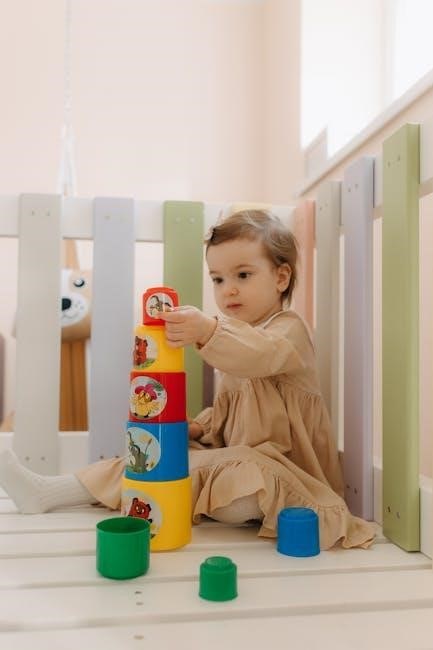
The Role of the Montessori Teacher
Montessori syllabus PDFs empower teachers to cultivate independence, observing each child’s unique learning journey and fostering a prepared environment for optimal growth.
The Prepared Environment & Teacher’s Role
A Montessori syllabus PDF meticulously details how the teacher’s role transcends traditional instruction; they become a guide, observing and responding to the child’s self-directed activity within a carefully curated environment. This environment, described within the syllabus, isn’t merely a classroom, but a space intentionally designed to foster independence, concentration, and a love of learning.
The PDF outlines specific material arrangements, emphasizing accessibility and order. Teachers utilize these resources to present lessons individually or in small groups, always following the child’s lead; Crucially, the syllabus stresses the importance of indirect guidance – allowing children to explore, experiment, and learn from their mistakes. The teacher’s role is to prepare the environment, observe the child’s interactions, and offer support only when needed, fostering a sense of self-reliance and intrinsic motivation. This approach, detailed in the syllabus, builds reliable and energy-efficient learning systems.
Observation and Individualized Learning Plans
A comprehensive Montessori syllabus PDF emphasizes systematic observation as the cornerstone of individualized learning. Teachers aren’t simply delivering a standardized curriculum; they are meticulously tracking each child’s progress, interests, and challenges. The syllabus provides detailed guidelines on how to observe – noting concentration levels, work habits, and areas of difficulty;
This observational data then informs the creation of individualized learning plans, outlined within the PDF, tailored to each child’s unique needs and pace. These plans aren’t rigid prescriptions, but rather flexible frameworks that adapt as the child develops. The syllabus stresses the importance of documenting observations and using them to adjust the learning environment and materials, mirroring the principles of building reliable and energy-efficient computer systems through iterative refinement. This ensures each child receives precisely the support they need to thrive.

Future Trends in Montessori Education
Montessori syllabus PDFs increasingly integrate technology, mirroring advancements in computer architecture and high-performance computing, to enhance learning experiences for all children.
Montessori and Technology Integration
The evolving landscape of education witnesses a growing intersection between Montessori principles and technological tools, readily accessible through comprehensive Montessori syllabus PDFs. These digital resources are no longer simply supplementary; they are becoming integral components of a modern Montessori classroom; The integration isn’t about replacing hands-on materials, but rather enriching the learning experience.
Syllabus PDFs now often include links to interactive software, virtual field trips, and digital manipulatives that complement traditional lessons. This mirrors advancements in fields like computer architecture and high-performance computing, where complex systems are built upon foundational principles. Educators are leveraging technology to personalize learning paths, track student progress more effectively, and foster independent exploration. However, mindful implementation is key – technology should serve the child, not the other way around, upholding the core Montessori tenet of child-led discovery.
Montessori for Children with Special Needs
Montessori syllabus PDFs increasingly demonstrate adaptability for children with diverse learning needs, reflecting a commitment to inclusive education. The method’s emphasis on individualized learning, a prepared environment, and hands-on materials naturally lends itself to supporting students with various challenges. These PDFs often contain modifications and extensions for lessons, catering to specific disabilities like autism, dyslexia, or ADHD.
The core principles – observation, individualized pacing, and sensorial exploration – are particularly beneficial. Detailed syllabus resources outline strategies for creating accessible learning experiences, utilizing assistive technologies, and fostering a sense of independence. Just as building reliable computer systems requires addressing multiple disciplines, supporting children with special needs demands a holistic and adaptable approach, guided by well-structured curriculum materials.